In this truth study we will explore “faith” as it applies to Christianity. Faith, in this study, implies faith in our triune God (God the Father, God the Son, and God the Holy Spirit) and faith in the Word of God.
Faith is pivotal in every book of the Bible. Men and women were lauded for their faith, and their exploits of faith are extolled from Genesis to Revelation. In the Gospels, the Lord Jesus rebuked His disciples for their lack of faith. Entire books and even series of books have been written about faith in God and His Word. This truth study will in no way be complete or exhaustive, but it will serve as a launch pad or a warmup for your future study and learning.
The word “faith” in English Bibles is translated from the Greek word “pistis” (Strongs G4102) and occurs about 240 times in the New Testament. Pistis has meanings that include “conviction of the truth of anything,” “belief,” and “a conviction or belief respecting man’s relationship to God and divine things.” Related to “faith” are the words “believe” and “belief.” The English word “believe” is translated from the Greek word “pisteuo” (Strongs G4100). This word occurs about 250 times in the New Testament. “Pisteuo” has meanings that include “to think to be true,” “to be persuaded of,” “to credit,” and “to place confidence in.”
The Bible defines faith in Hebrews 11.
Hebrews 11:1 (NKJV)
Now faith is the substance of things hoped for, the evidence of things not seen.
Faith is not an abstract concept but it is defined as a “substance” and “evidence.” While “hope” is the confident expectation of good, faith is more than an expectation, it has substance. When you have faith, you have assurance. When you have faith, you are convinced.
This verse is expanded in the Amplified Classic Bible and the Amplified Bible.
Hebrews 11:1 (AMPC)
Now faith is the assurance (the confirmation, the title deed) of the things [we] hope for, being the proof of things [we] do not see and the conviction of their reality [faith perceiving as real fact what is not revealed to the senses].
Hebrews 11:1 (AMP)
Now faith is the assurance (title deed, confirmation) of things hoped for (divinely guaranteed), and the evidence of things not seen [the conviction of their reality—faith comprehends as fact what cannot be experienced by the physical senses].
While hope is a confident expectation of the fulfilment of a promise of God, faith is the confirmation and assurance that the promise will manifest. Faith can be thought of as a “title deed” to a promise of God. When you have a title deed, you have ownership. When you have faith in a promise, it is already yours even if it has not yet appeared in the physical realm. Hope is in the future, but faith is now.
We begin our new life in Christ by faith, and only by faith.
Romans 5:1 (NLT)
Therefore, since we have been made right in God’s sight by faith, we have peace with God because of what Jesus Christ our Lord has done for us.
Romans 5:1 (AMP)
Therefore, since we have been justified [that is, acquitted of sin, declared blameless before God] by faith, [let us grasp the fact that] we have peace with God [and the joy of reconciliation with Him] through our Lord Jesus Christ (the Messiah, the Anointed).
Notice that we are made right with God or “justified” by our faith in the finished work of Jesus on the cross. In the book of Philippians, the Apostle Paul states that genuine or authentic righteousness and right-standing before God come only by faith in Jesus Christ.
Philippians 3:9 (AMP)
…and may be found in Him [believing and relying on Him], not having any righteousness of my own derived from [my obedience to] the Law and its rituals, but [possessing] that [genuine righteousness] which comes through faith in Christ, the righteousness which comes from God on the basis of faith.
Genuine or authentic right-standing with God only comes by faith in Jesus. Paul explains that we are saved and put into right relationship with God by faith in Jesus Christ again in his letter to the Galatians.
Galatians 2:16 (NASB 1995)
…nevertheless knowing that a man is not justified by the works of the Law but through faith in Christ Jesus, even we have believed in Christ Jesus, so that we may be justified by faith in Christ and not by the works of the Law; since by the works of the Law no flesh will be justified.
There is no salvation, no new birth, no new creation without faith in the finished work of the Lord Jesus Christ. We must believe that the sacrifice of Jesus met the requirements of justice for our sins. We must believe that the blood Jesus shed washed away our sins. We must have faith in Jesus.
Paul told the Ephesians that salvation is accomplished by grace through faith. How does a person acquire this faith to be saved by grace?
Ephesians 2:8, 9 (NKJV)
8 For by grace you have been saved through faith, and that not of yourselves; it is the gift of God, 9 not of works, lest anyone should boast.
The phrase “that not of yourselves” could apply to the “grace” or to the “faith.” Paul could be saying that the “grace” is not of yourselves, and that is surely true because grace is from God and not us. Or Paul could be saying that “faith” is not of ourselves.
For more clarity, consider Hebrews 12.
Hebrews 12:2 (NASB 1995)
… fixing our eyes on Jesus, the author and perfecter of faith, who for the joy set before Him endured the cross, despising the shame, and has sat down at the right hand of the throne of God.
Hebrews 12:2 (AMPC)
Looking away [from all that will distract] to Jesus, Who is the Leader and the Source of our faith [giving the first incentive for our belief] and is also its Finisher [bringing it to maturity and perfection]. He, for the joy [of obtaining the prize] that was set before Him, endured the cross, despising and ignoring the shame, and is now seated at the right hand of the throne of God.
This verse states that Jesus Himself is the source or author of our faith. He prompts or incentivizes our faith in His gospel. In Romans, Paul states that we are given a “measure” of faith.
Romans 12:3 (NKJV)
For I say, through the grace given to me, to everyone who is among you, not to think of himself more highly than he ought to think, but to think soberly, as God has dealt to each one a measure of faith.
God gives or distributes faith to each person in a “measure.” It is probable that each person receives the exact same measure of faith because God is no respecter of people. He treats each of us the same (Rom. 2:11, Acts 10:34, Mal. 3:6, Heb. 3:8).
While we each receive the same amount of faith, we also receive the same kind of faith. The Apostle Peter says that we obtain a “like precious faith.”
2 Peter 1:1 (NKJV)
Simon Peter, a bondservant and apostle of Jesus Christ, To those who have obtained like precious faith with us by the righteousness of our God and Savior Jesus Christ:
This is a beautiful and poetic phrase, “like precious faith.” But look at the New American Standard Bible version of this verse.
2 Peter 1:1 (NASB 1995)
Simon Peter, a bond-servant and apostle of Jesus Christ, To those who have received a faith of the same kind as ours, by the righteousness of our God and Savior, Jesus Christ:
Everyone receives the same kind of faith. It is granted by Jesus, as Hebrews tells us He is the Author and Source of our faith. We receive a kind of faith that allows us to believe the Gospel.
When is this faith given? At the hearing of the gospel of Jesus Christ.
Faith comes from the Lord Jesus Christ, and it comes from the hearing Word of God. When the gospel is preached, it is accompanied by faith to believe the message. Faith comes with the message.
Romans 10:17 (NKJV)
So then faith comes by hearing, and hearing by the word of God.
Romans 10:17 (AMP)
So faith comes from hearing [what is told], and what is heard comes by the [preaching of the] message concerning Christ.
Notice that in the New King James Version (and many other versions), faith comes by hearing the word of God. In the Amplified Bible and the Amplified Classic, faith comes by hearing the “message concerning Christ” which is more specific than “the word of God.” The actual word “God” or “Christ” is translated from the Greek word “Christos” (Strongs G5547). This word means “anointed,” therefore Jesus Christ is Jesus the Anointed. The initial Jesus-given measure of faith comes by hearing the message of Jesus’s work in redeeming humanity.
The context of “faith comes by hearing” the gospel message follows.
Romans 10:14-17 (NLT)
14 But how can they call on him to save them unless they believe in him? And how can they believe in him if they have never heard about him? And how can they hear about him unless someone tells them? 15 And how will anyone go and tell them without being sent? That is why the Scriptures say, “How beautiful are the feet of messengers who bring good news!” 16 But not everyone welcomes the Good News, for Isaiah the prophet said, “Lord, who has believed our message?” 17 So faith comes from hearing, that is, hearing the Good News about Christ.
Jesus provides faith for salvation when the gospel is preached. Some people hear and choose to humble themselves and accept or receive the gospel and with it the faith to believe. Some people hear and choose to mock, ridicule, and reject the gospel and the faith that accompanies the preaching of the word of Christ. They refuse to surrender to Jesus and the gospel; therefore, they hear but go away unsaved.
Jesus is the Author of our faith (Heb. 12:2) and we each receive the same kind of faith (2 Pet. 1:1). How much faith does Jesus give us? As stated above, we are given a “measure” of faith.
Romans 12:3 (NKJV)
For I say, through the grace given to me, to everyone who is among you, not to think of himself more highly than he ought to think, but to think soberly, as God has dealt to each one a measure of faith.
As stated above, since God is no respecter of persons and does not show partiality, one could assume that “a measure” is the same for all people. In terms of its size, Jesus compared it to a mustard seed.
Luke 17:6 (AMPC)
And the Lord answered, If you had faith (trust and confidence in God) even [so small] like a grain of mustard seed, you could say to this mulberry tree, Be pulled up by the roots, and be planted in the sea, and it would obey you.
Mustard seeds are very small – much smaller than an apple seed or a kernel of corn. Clearly, it does not take much faith to accomplish great feats! In Matthew 17:20, Jesus also speaks of faith the size of a mustard seed. Faith in God and faith in His word are very powerful. According to Jesus, if you believe and do not doubt, mountains can be moved!
So far in this study we have seen that we are born again by faith in the Lord Jesus Christ and all He is and has done for us in redemption. Faith is given to us by Jesus when we hear the gospel preached. The person who chooses to embrace the faith given and believe the gospel becomes a new creation in Christ. Initially, we all receive the same kind of faith and the same measure of faith. Faith is very powerful.
Now what? Is faith just for the transition from sinner to Christian? Is faith just for the salvation experience? No. We are called to live every moment of the rest of our lives by faith! Here is what the Apostle Paul told the Colossians:
Colossians 2:6 (NKJV)
As you therefore have received Christ Jesus the Lord, so walk in Him,
Colossians 2:6 (AMPC)
As you have therefore received Christ, [even] Jesus the Lord, [so] walk (regulate your lives and conduct yourselves) in union with and conformity to Him.
How did you receive Jesus? By believing the word preached about His work in redemption. How did you receive Jesus? By believing the gospel message you heard. How did you receive Jesus? By faith. We live, move, and navigate through life by faith in God’s Son Jesus and by believing the Bible.
Galatians 2:20 (NASB 1995)
I have been crucified with Christ; and it is no longer I who live, but Christ lives in me; and the life which I now live in the flesh I live by faith in the Son of God, who loved me and gave Himself up for me.
The life that we live after the new birth is a life lived by faith in the Son of God. Jesus does not just give us faith for the initial new birth experience and then say, “Okay, you are on your own now.” Each day we live by believing in Jesus and His word and allowing Him to develop our faith.
2 Corinthians 5:7 (NKJV)
For we walk by faith, not by sight.
A Christian can live every day as an adventure in faith. In every relationship, in every circumstance, and in every challenge, we can live our lives by faith in the word and wisdom of God.
God expects us to live by faith. The phrase “the righteous shall live by faith” occurs four times in scripture, once in the Old Testament and three times in the New Testament.
(A note about the use of the word “righteous” – If you are born again, you have received the righteousness of Christ (2 Cor. 5:21). You must identify as righteous through Jesus’s gift of His own righteousness to you. God “justifies” you at the new birth by imputing or accounting Jesus’s right-standing with Himself as your right-standing with Himself. Your righteousness is not about your feelings – whether you feel righteous or not – it is about your legal standing before God in the New Covenant.)
Consider these verses from Habakkuk, Romans, Galatians, and Hebrews.
Habakkuk 2:4 (NASB 1995)
“Behold, as for the proud one, His soul is not right within him; But the righteous will live by his faith.
Romans 1:17 (NASB 1995)
For in it the righteousness of God is revealed from faith to faith; as it is written, “But the righteous man shall live by faith.”
Galatians 3:11 (NASB 1995)
Now that no one is justified by the Law before God is evident; for, “The righteous man shall live by faith.”
Hebrews 10:38 (NASB 1995)
But My righteous one shall live by faith; And if he shrinks back, My soul has no pleasure in him.
Holy Spirit includes this statement in scripture four times. It is important. It only takes a fraction of a second to be born again – to have your spirit reborn and become a child of God by faith. But then we must learn to walk and regulate our lives day in and day out by faith. Making progress and navigating this life on earth as a Christian requires faith. Sometimes it requires moment by moment faith in God’s Word and His promises.
The eleventh chapter of the book of Hebrews has been called the “faith hall of fame” and begins with a definition of faith as seen in Hebrews 11:1.
Hebrews 11:1 (NKJV)
Now faith is the substance of things hoped for, the evidence of things not seen.
In verse three, we see that faith gives us understanding of God’s creation of this universe.
Hebrews 11:3 (NASB 1995)
By faith we understand that the worlds were prepared by the word of God, so that what is seen was not made out of things which are visible.
In the first chapter of the book of Genesis, we are told that God spoke, and this world was created. There is a detailed account of God speaking and creation appearing in Genesis 1. According to Hebrews 11:3, what is now seen in creation was not made from visible things but by the words God spoke. By faith God spoke creation into existence and by faith we understand it. How do we know that God used faith to create?
When combined, Hebrews 11:1 Hebrews 11:3 tell us that faith is the substance of things hoped for and, that what is seen was not made of that which is visible. The key to getting from not seeing creation to seeing creation was God’s spoken words of faith. The words God spoke brought the invisible to visibility.
The writer of Hebrews states that it is actually impossible to please God without faith.
Hebrews 11:6 (NASB 1995)
And without faith it is impossible to please Him, for he who comes to God must believe that He is and that He is a rewarder of those who seek Him.
Hebrews 11:6 (MSG)
It’s impossible to please God apart from faith. And why? Because anyone who wants to approach God must believe both that he exists and that he cares enough to respond to those who seek him.
Small acts of faith as well and great acts of faith give our Heavenly Father delight. The Apostle Paul went so far as to say that anything apart from faith is sin. In a discussion about dietary laws and arguments about what can and cannot be eaten, Paul says the following:
Romans 14:23 (NKJV)
But he who doubts is condemned if he eats, because he does not eat from faith; for whatever is not from faith is sin.
After being saved by faith, we must begin to live by faith. Hebrews 11 lists many Old Testament saints and their acts of faith. A few are listed below.
Offerings should be given in faith. Consider Adam and Eve’s son Abel.
Hebrews 11:4 (NASB 1995)
By faith Abel offered to God a better sacrifice than Cain, through which he obtained the testimony that he was righteous, God testifying about his gifts, and through faith, though he is dead, he still speaks.
Here we see Abel brought God an offering by faith. God says that the faith this man used to bring the offering has lasted for thousands of years because “it still speaks.”
Noah built the ark, filled it with animals, and waited for rain because he had faith in what God spoke to Him and commanded him to do.
Hebrews 11:7 (NASB 1995)
By faith Noah, being warned by God about things not yet seen in reverence prepared an ark for the salvation of his household, by which he condemned the world, and became an heir of the righteousness which is according to faith.
Notice that even this Old Testament man enjoyed righteousness by faith. His belief in God’s words to him and acting on those words brought him right standing with God.
Abraham left his home and travelled to unknown places because he had faith in God.
Hebrews 11:8 – 10 (NKJV)
8 By faith Abraham obeyed when he was called to go out to the place which he would receive as an inheritance. And he went out, not knowing where he was going. 9 By faith he dwelt in the land of promise as in a foreign country, dwelling in tents with Isaac and Jacob, the heirs with him of the same promise; 10 for he waited for the city which has foundations, whose builder and maker is God.
By faith, Sarah, who had a barren womb and was well past child-bearing age, was able to conceive and give birth to her son Isaac.
Hebrews 11:11 (NKJV)
By faith Sarah herself also received strength to conceive seed, and she bore a child when she was past the age, because she judged Him faithful who had promised.
As you proceed through Hebrews 11, Holy Spirit describes people acting in faith and receiving God’s praise and commendation. Both men and women are described as “having obtained a good testimony.”
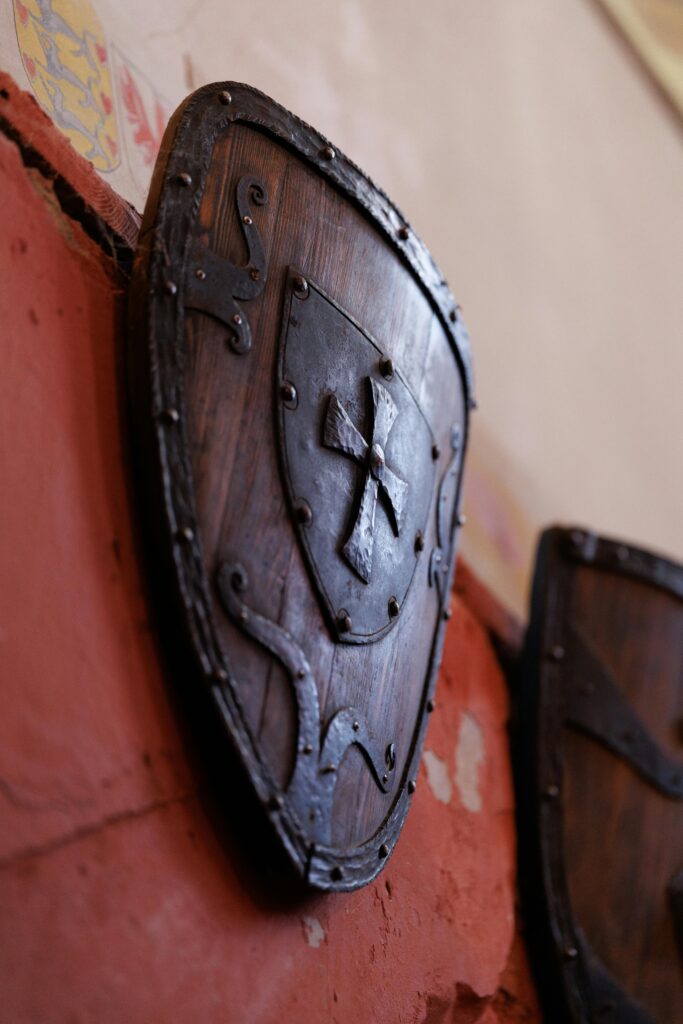
Faith can also be used as a shield. In the book of Ephesians, the Apostle Paul describes the “armor of God.” It is simply a fact that we are born into a world at war. There are natural wars going on in the physical world and there are wars and battles going on in the spirit realm. The topic of this Truth study in not spiritual warfare, but any discussion of faith must point out the “shield of faith.” While we are born into a war zone, we have not been left defenseless. There is a suit of armor we learn to put on. And there is a shield of faith included in that armor.
Ephesian 6:10-17 (NLT)
10 A final word: Be strong in the Lord and in his mighty power. 11 Put on all of God’s armor so that you will be able to stand firm against all strategies of the devil. 12 For we are not fighting against flesh-and-blood enemies, but against evil rulers and authorities of the unseen world, against mighty powers in this dark world, and against evil spirits in the heavenly places. 13 Therefore, put on every piece of God’s armor so you will be able to resist the enemy in the time of evil. Then after the battle you will still be standing firm. 14 Stand your ground, putting on the belt of truth and the body armor of God’s righteousness. 15 For shoes, put on the peace that comes from the Good News so that you will be fully prepared. 16 In addition to all of these, hold up the shield of faith to stop the fiery arrows of the devil. 17 Put on salvation as your helmet, and take the sword of the Spirit, which is the word of God.
Holy Spirit instructs us to “hold up the shield of faith to stop the fiery arrows of the devil.” It is not hard to imagine what a “fiery arrow of the devil” would be. Satan is our enemy and he is trying to destroy each of our destinies. After we are born again, he has no influence over our eternal destiny, but he will try very hard to shipwreck our callings and assignments in this temporal life. He would prevent us from reaching our destiny if he could, but as Christians we learn to fight back. One way to engage the enemy is defensive. Hold up the shield of faith. When God exercised His faith in creation, He spoke. “Let there be light.” Light came into existence. As born-again believers, we learn to use the shield of faith with words.
Mark 11:22, 23 (NLT)
22 Then Jesus said to the disciples, “Have faith in God. 23 I tell you the truth, you can say to this mountain, ‘May you be lifted up and thrown into the sea,’ and it will happen. But you must really believe it will happen and have no doubt in your heart.
In Genesis 1, God spoke by faith and creation came into existence. Genesis 1 is an object lesson. By faith, speak what you desire. Jesus claims a mountain will move into the sea if you tell it to do so without doubting.
Paul wrote to the believers at Corinth that believing leads to speaking.
2 Corinthians 4:13 (NIV)
It is written: “I believed; therefore I have spoken.” Since we have that same spirit of faith, we also believe and therefore speak,
We find the original statement was made by King David in Psalms 116:10.
Returning to the discussion of the armor of God, we see that the shield of faith will stop the fiery arrows of the devil.
Ephesians 6:16 (NLT)
In addition to all of these, hold up the shield of faith to stop the fiery arrows of the devil.
The New American Standard Bible uses the word “extinguish” as the effect of the shield of faith on a fiery arrow. In the King James Version, the word is “quench.”
Ephesians 6:16 (NASB 1995)
…in addition to all, taking up the shield of faith with which you will be able to extinguish all the flaming arrows of the evil one.
Ephesians 6:16 (KJV)
Above all, taking the shield of faith, wherewith ye shall be able to quench all the fiery darts of the wicked.
The imagery of “extinguishing” or “quenching” the fiery arrows or darts sent to harm us is faith building. Meditating or pondering the action of our faith to end an attack of Satan encourages us. Imagine using your shield of faith to reduce a fiery arrow to a smoking stick of wood lying on the ground at your feet. Fiery darts or arrows could be health problems, financial problems, relationship problems, or any challenge we face in this earth. When a flaming arrow has been launched at us from the enemy, the following prayer and declaration is an example of how to use words to engage the shield of faith.
“In the Name of Jesus, I lift up the shield of faith against this flaming arrow and extinguish it now. Greater is He that is in me than he that is in the world. I take my authority as a child of God and quench this attack. No weapon formed against me will prosper.”
The verses 1 John 4:4 and Isaiah 54:17 quoted above are just two verses of hundreds of scriptures that can be used to extinguish the enemy’s flaming arrows.
You can describe the arrow in your declaration and be specific.
“In the Name of Jesus, I lift up the shield of faith against this illness that has come against my child. I quench this fiery dart of illness and forbid it from remaining in my child’s body. I declare that God is Jehovah Rapha – the Lord Our Physician, the Lord that Heals – over my child. I resist you Satan and I resist this illness. Thank you, Lord, for healing for my child.”
Use your sanctified imagination to see that flaming arrow of illness stopped by your shield of faith and fall a your feet – just an extinguished, smoking stick.
When using the shield of faith, ask Holy Spirit to help you make anointed and effective declarations. He is your Helper and your Counselor.
Our faith is given to us by Jesus (Heb 12:2) and it is given in a measure (Rom. 12:3). Can that measure increase? Can our faith get stronger or larger? Can we be good stewards of our faith and take steps to strengthen it? Can we neglect our faith by being poor stewards and experience a lack of faith? In the Gospels (especially the book of Matthew), Jesus uses the phrases “great faith” and “little faith” often to describe the faith displayed by a person.
There are Bible teachers that compare faith to a muscle. If it is used and trained, a muscle will grow and become stronger. If a muscle is not used, it can atrophy and become weak. If faith can be strengthened, how is it done?
In the book of Acts, it is reported that whole churches were strengthened in faith. This book was written in the early days of Christianity and the early church of Jesus Christ.
Acts 16:4, 5 (AMP)
4 As they traveled from town to town, they delivered the decrees decided on by the apostles and elders who were in Jerusalem, for the churches to observe. 5 So the churches were strengthened in the faith, and they continually increased in number day after day.
As the churches were taught and instructed in the new gospel of grace and the new covenant, the people’s faith was strengthened. As mentioned earlier, faith comes by hearing the word of Christ (Rom. 10:17) and faith grows stronger by hearing Jesus preached.
The Apostle Paul describes Abraham’s faith in Romans 4. Abraham is known as “the father of faith” and a “friend of God” (Is. 41:8, 2 Chron. 20:7, James 2:23). Abraham was given a promise from God that was humanly impossible. God promised him that he and his wife Sarah would have a child and that nations would grow out of that child (Genesis 12 and 17). Sarah was barren and when the promise was given, and both Abraham and Sarah were very old. God told Abraham that Sarah would have a child even though she was barren and past child-bearing age. Romans 4:18-25 describes the situation and Abraham’s response.
Romans 4:18-25 (AMP)
18 In hope against hope Abraham believed that he would become a father of many nations, as he had been promised [by God]: “So [numberless] shall your descendants be.” 19 Without becoming weak in faith he considered his own body, now as good as dead [for producing children] since he was about a hundred years old, and [he considered] the deadness of Sarah’s womb. 20 But he did not doubt or waver in unbelief concerning the promise of God, but he grew strong and empowered by faith, giving glory to God, 21 being fully convinced that God had the power to do what He had promised. 22 Therefore his faith was credited to him as righteousness (right standing with God). 23 Now not for his sake alone was it written that it was credited to him, 24 but for our sake also—to whom righteousness will be credited, as those who believe in Him who raised Jesus our Lord from the dead— 25 who was betrayed and crucified because of our sins, and was raised [from the dead] because of our justification [our acquittal—absolving us of all sin before God].
Abraham had no natural or physical reason to believe God. He simply chose to believe the promise God gave him and not doubt. In fact, Paul says he, “being fully convinced,” did not grow weary or become weak in faith as the years passed (about ten years). This is the exact method for exercising faith. God gives a promise (usually it will look impossible), we learn of the promise by studying the scriptures and listening to the word of Christ preached, we believe the promise and refuse to doubt or waver until the promise manifests in our life.
The time that passes between receiving a promise from God and the manifestation of that promise is important. As time passed, Abraham grew stronger in faith, not weaker. As time passes, faith grows stronger. Isaiah says waiting on God increases our strength.
Isaiah 40:31 (AMP)
But those who wait for the Lord [who expect, look for, and hope in Him] Will gain new strength and renew their power; They will lift up their wings [and rise up close to God] like eagles [rising toward the sun]; They will run and not become weary, They will walk and not grow tired.
This describes Abraham’s experience and this is our experience. Standing and waiting in faith for a promise to manifest is not punishment. God is not ignoring us. God does not make his beloved children wait for answers to prayers because He is unwilling or hesitant. Waiting renews faith and strengthens us.
James says that the “testing of our faith” works patience leading to spiritual maturity.
James 1:2-4 (AMP)
2 Consider it nothing but joy, my brothers and sisters, whenever you fall into various trials. 3 Be assured that the testing of your faith [through experience] produces endurance [leading to spiritual maturity, and inner peace]. 4 And let endurance have its perfect result and do a thorough work, so that you may be perfect and completely developed [in your faith], lacking in nothing.
There are no shortcuts to Christian growth and spiritual stature. Faith must be exercised over periods of time.
Romans 5:2-5 (TLB)
2 For because of our faith, he has brought us into this place of highest privilege where we now stand, and we confidently and joyfully look forward to actually becoming all that God has had in mind for us to be. 3 We can rejoice, too, when we run into problems and trials, for we know that they are good for us—they help us learn to be patient. 4 And patience develops strength of character in us and helps us trust God more each time we use it until finally our hope and faith are strong and steady. 5 Then, when that happens, we are able to hold our heads high no matter what happens and know that all is well, for we know how dearly God loves us, and we feel this warm love everywhere within us because God has given us the Holy Spirit to fill our hearts with his love.
The Christian who has “strong and steady” faith has a big advantage over the person who is tossed around or buffeted by every trial or challenge (James 1:6). Like Abraham, our goal should be perseverance in faith.
The Apostle Jude has instructions for building faith. He states that by praying in the Holy Spirit, we build ourselves up. Praying in the Holy Spirit is often referred to as praying in tongues. In the Truth Study titled “Holy Spirit: Language” the description of a personal prayer and worship language is presented. Using your own personal prayer language and praying in the spirit will build your faith.
Jude 1:20 (NKJV)
But you, beloved, building yourselves up on your most holy faith, praying in the Holy Spirit,
Jude 1:20 (AMPC)
But you, beloved, build yourselves up [founded] on your most holy faith [make progress, rise like an edifice higher and higher], praying in the Holy Spirit;
Spend time praying, worshiping, and singing in your personal prayer language and it will nurture and feed your faith causing it to be strengthened.
Faith is also strengthened and perfected by the Lord Jesus Christ Himself. Earlier Hebrews 12:2 was presented to show where faith comes from. Faith comes from Jesus when the gospel is preached (Rom. 10:17)
Hebrews 12:2a (NLT)
We do this by keeping our eyes on Jesus, the champion who initiates and perfects our faith
Hebrews 12:2a (NIV)
…fixing our eyes on Jesus, the pioneer and perfecter of faith.
Hebrews 12:2a (AMPC)
Looking away [from all that will distract] to Jesus, Who is the Leader and the Source of our faith [giving the first incentive for our belief] and is also its Finisher [bringing it to maturity and perfection].
Jesus initiates our faith, pioneers our faith, and is the source of our faith. But notice that He also takes the responsibility to perfect our faith and to bring it to maturity. We can call upon Him to fulfill His role as the perfecter of our faith every day. We can reach out to Him in prayer to strengthen and complete our faith in every situation and circumstance of life. He is Leader, the Source, and the One who assists us in always exercising our faith.
The writer of the book of Hebrews states that without faith, it is impossible to please God (Heb. 11:6). The Apostle Paul, one of the giants of faith, said the following at the end of his life.
2 Timothy 4:7,8 (NASB 1995)
I have fought the good fight, I have finished the course, I have kept the faith; 8 in the future there is laid up for me the crown of righteousness, which the Lord, the righteous Judge, will award to me on that day; and not only to me, but also to all who have loved His appearing.
“I have kept the faith.” Like the patriarch of faith, Abraham, Paul never let go of his faith. He kept the faith to the end. These words have encouraged many saints throughout the ages. Let them be your anthem and your heart’s desire.
In conclusion:
- Hebrews 11 and Romans 4 are excellent chapters to study for information and revelation about faith.
- Faith is a substance; it is not a feeling – Heb. 11:1
- Without faith it is impossible to please God and whatever does not proceed from faith is sin – Heb. 11:6, Rom. 14:23
- Jesus provides faith for us to believe the gospel and faith comes from hearing the gospel of Jesus Christ preached – Heb. 12:2, Rom. 10:17
- We are each given a measure of faith and we are each given the same kind of faith – Rom. 12:3, 2 Pet. 1:1.
- Christians are saved by faith and then must live their lives by faith – Rom. 5:1, Col. 2:6; Heb. 10:38.
- There is a shield of faith in our spiritual armor that enables us to stop fiery arrows of the enemy – Eph. 6:16
- Faith can grow stronger if we steward it – Acts 16:5, Rom. 4:20, Jude 1:20
- It is often necessary to exercise faith over a period of time, and this builds spiritual maturity – Is. 40:31, James 1:2,3.